

South Korea impressed in their World Cup opener versus Czech Republic with a 2-1 win. While Korea struggled with Czech Republic's set-pieces, creating a tight and hard-fought game, they dominated in open-play sequences.
In this article we will showcase some of South Korea's main attacking characteristics, and how they were able to punish Czech Republic with a combination of tactical discipline, relational movements and individual excellence.
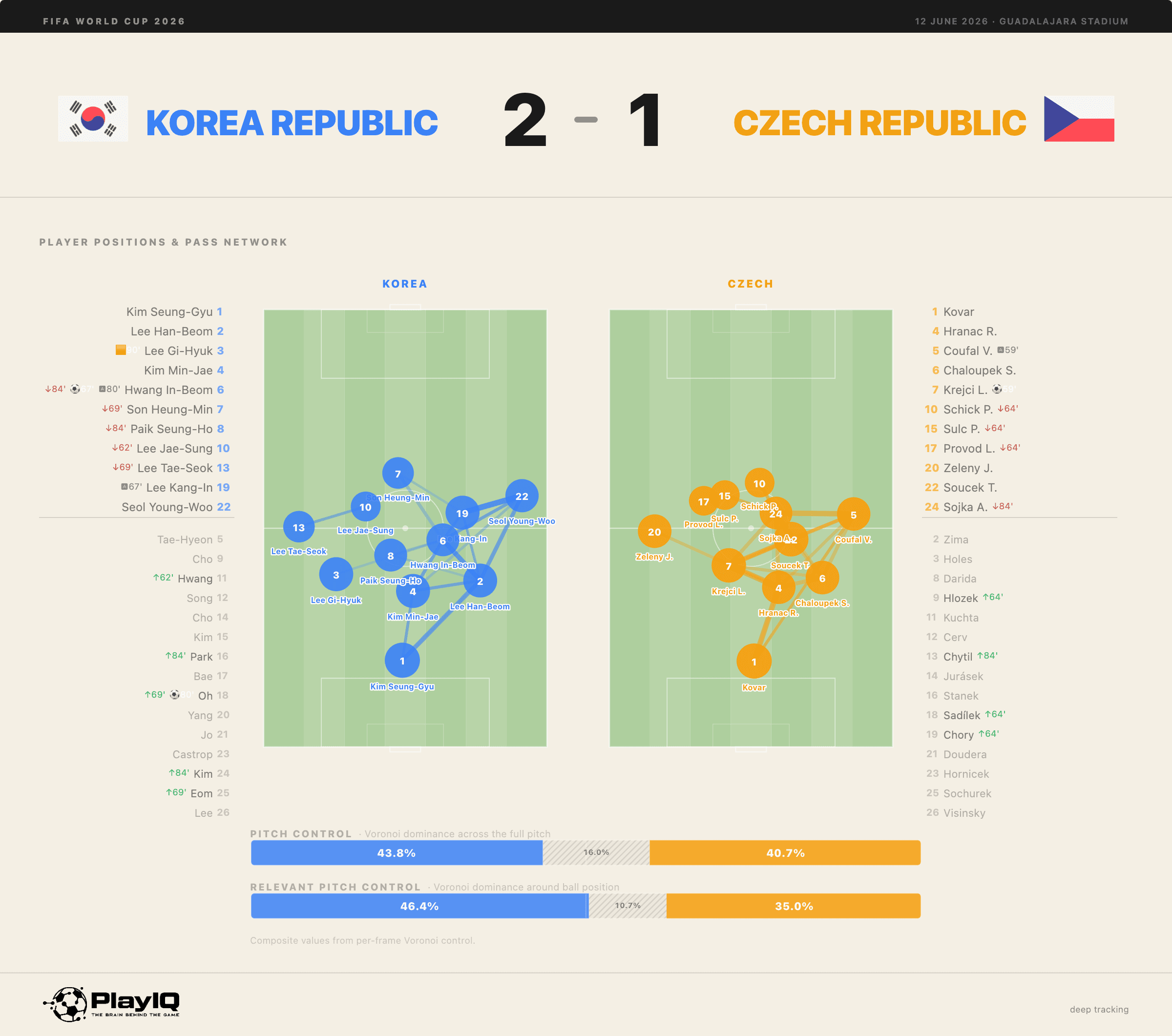
The match dashboard above shows the average position and passing network of players in both teams when faced with a medium block. Our first observation is how similar the two structures are in possession: both sides set up with wingbacks as their primary width holders and kept relatively compact, central passing networks that broadly reflect their on-paper shapes. That said, South Korea's shape does look a touch more expansive: their wingbacks held a noticeably higher position on the pitch than the Czech's, stretching the network further up the field and giving it slightly more width and depth overall.
Another observation is that a couple of players stood out as especially involved for each side. Both teams leaned heavily on their right wing-back in build-up — Vladimír Coufal for Czech Republic and Seol Young-Woo for South Korea. Tomáš Souček was the other key connector in the Czech midfield, while for South Korea much of the play ran through right-sided attacking midfielder Lee Kang-In and the no. 6 Hwang In-Beom.
Regarding territory, the Korean team controlled both pitch control (43.8% to 40.7%) and relevant pitch control (46.4% to 35.0%). This means that the Korean team controlled the most space overall but also the most important spaces near and around the ball.
In the next section, we will analyse South Korea in possession, by looking at their attacking structures and how they managed to progress through lines. Later, we will show how Lee Kang-In held a central role within the Korean team.
Attacking Structure
South Korea's 3-4-3 structure is characterised by a combination of positional and fluid movements. Wingbacks Lee Tae-Seok and Seol Young-Woo repeatedly moved high and wide to stretch the Czech back five vertically and horizontally. Furthermore, they looked to keep a "box"-shape intact centrally, where attacking players could move in and between lines.
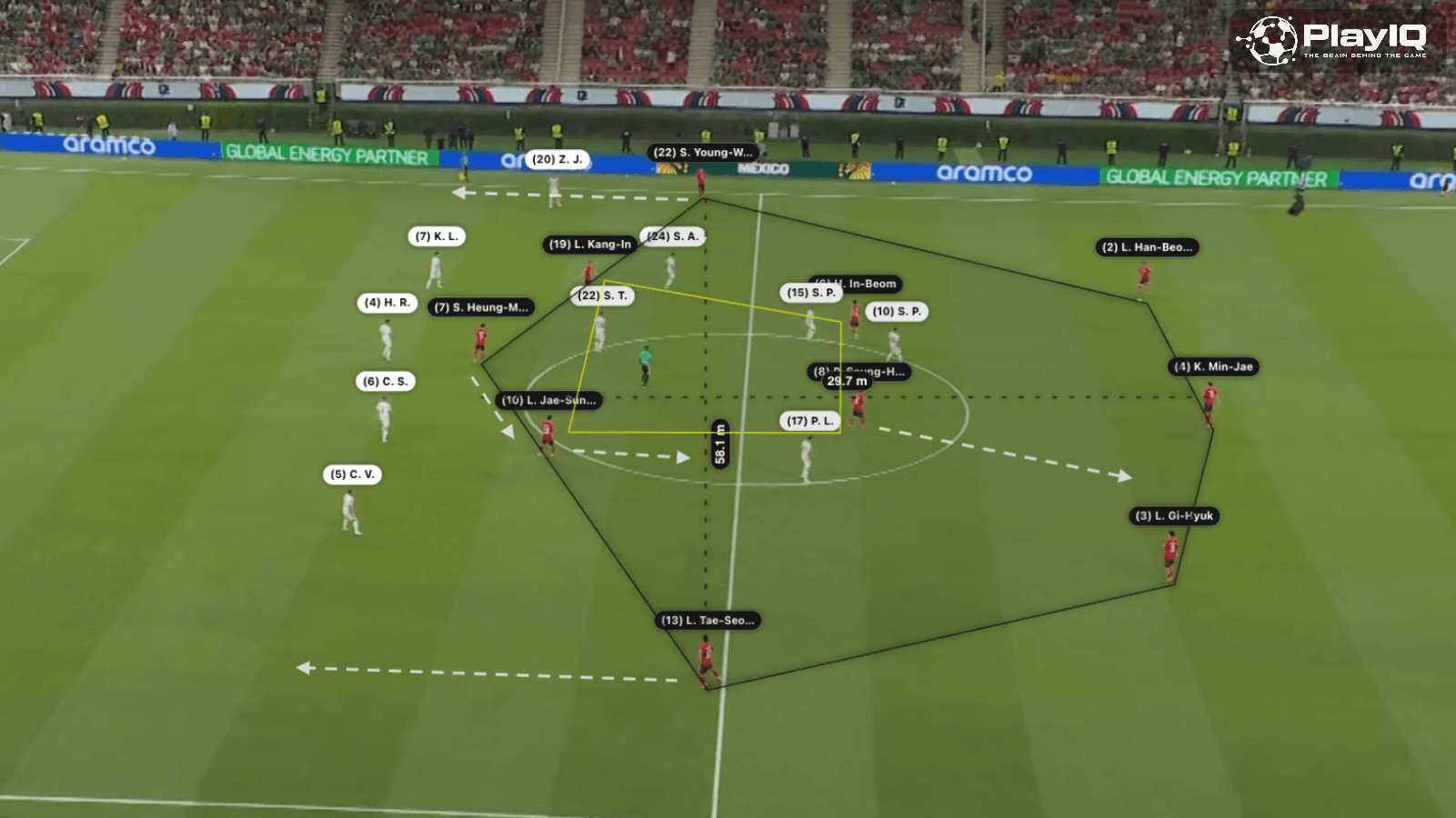
The image above showcases how South Korea often operated in attack against a medium block. The initial 3-4-3 shape quickly develops into a 4-2-4 shape in this phase in front of the first line of pressure. A key feature is that one of the central midfielders, in this case Paik Seung-Ho, drops into the defensive line to create a back four, initiating play outside of the Czech defensive block.
We also see that the box-shape centrally remains intact, with attacking midfielder Lee Jae-Sung dropping into the pocket Paik Seung-Ho has left, and striker Son Heung-Min filling his previous position. The result of this setup is that South Korea has numerical superiority in midfield. This was a key feature of South Korea's attacking structure and a major factor in breaking down Czech Republic, who spent long periods without the ball, as shown in the phase distribution chart below.
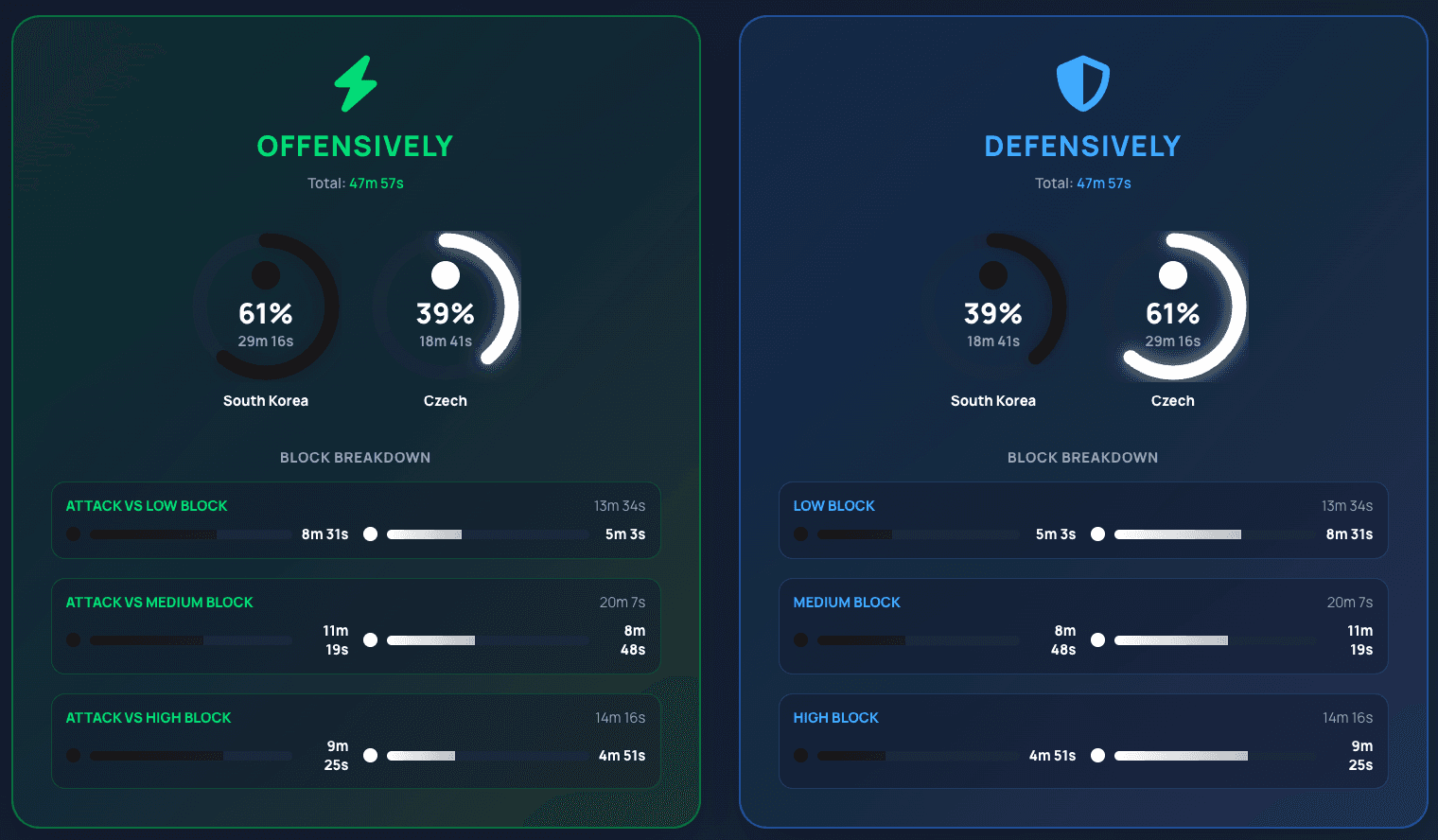
More interestingly, South Korea consistently progressed from building against a high block (9 minutes) to attacking against medium (11 minutes) and low blocks (8 minutes), demonstrating both control and progression through the thirds. But how exactly do they do this?
Positional Rotations
South Korea's positional rotations created the foundation for more fluid, relational movements. They consistently looked to combine through central areas and exploit their numerical superiority in midfield.
In the clip above, South Korea's box midfield is positioned between the Czech defensive lines, creating multiple options for combination play. As the Czech block shifts towards wing back Seol Young-Woo, he spots Lee Jae-Sung between the lines and finds him with a lofted pass.
From there, South Korea transitioned from positional occupation to quick relational play. Lee Jae-Sung immediately combines with Lee Kang-In, whose ability to receive under pressure destabilises the Czech shape. After evading several defenders, Kang-In exploited the space created by the Czech block's narrowness to progress the attack into wider areas.
This sequence highlights South Korea's tendency to look for Kang-In in decisive moments. His freedom within the attacking structure is a key mechanism for breaking down opposition defences, as the next section will further demonstrate.
The Individual Within the System: Lee Kang-In
Lee Kang-In stood out as the player in the Korean team who brought unpredictability to the system. Kang-In's positional freedom is especially evident when South Korea find themselves in attacking sequences higher in the pitch, as South Korea often search for him to initiate relational combinations over the positional movement patterns.
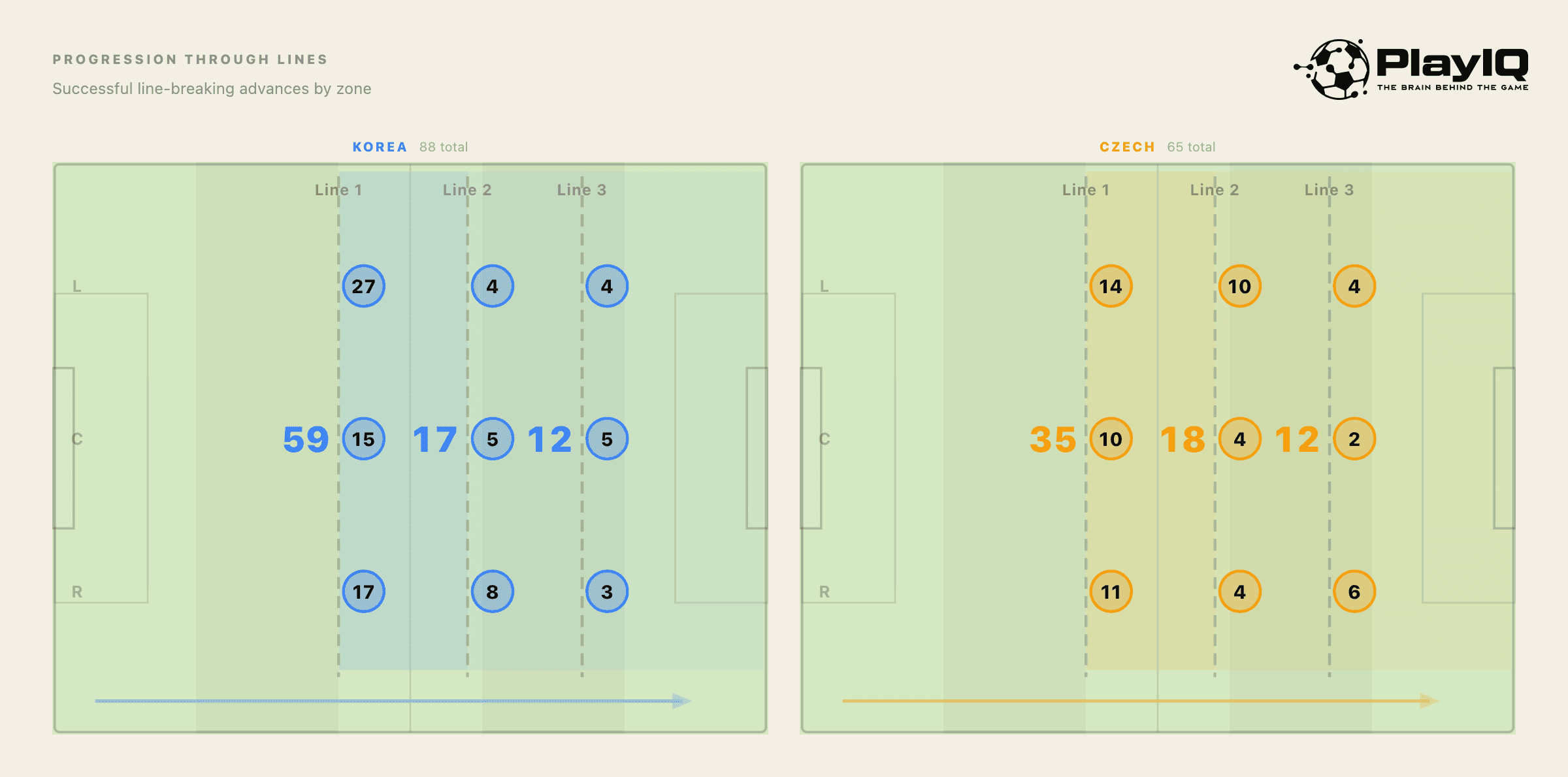
The progression chart highlights South Korea's ability to break lines across different areas of the pitch. They most frequently bypassed the first line of pressure on the left side (27 passes), often drawing the Czech block across before switching play. Once through the initial press, attacks were commonly directed towards the right side, where they recorded the most line-breaking passes through the second defensive line (8).
This pattern frequently brought Lee Kang-In into play. Operating as the right-sided attacking midfielder, he regularly drifted in and out of Czech Republic's narrow block, making him difficult to track without disrupting the defensive structure. His teammates complemented these movements by exploiting the spaces and passing angles he created.
The clips below highlight how Kang-In's movement and positioning consistently caused problems for the Czech defence.
The Creator
In this sequence, Kang-In drops deeper to receive possession. Rather than following him, Ladislav Krejčí holds his position to protect the last line, aware of the space that could open behind him as Seol Young-Woo stretches the Czech defensive structure horizontally.
Kang-In's technical quality is evident in his first touch, using the momentum of the pressing defender to turn into space and face the back line. From there, he quickly spots Jae-Sung Lee's run beyond a flat Czech defence and clips a pass into his path.
The Decoy
In this attack, Lee Kang-In moves as a decoy alongside Seol Young-Woo, drawing defenders away and creating a large gap in the inside channel. South Korea then exploits the space with a well-timed run from midfield, highlighting how Lee Kang-In's influence extends beyond his involvement on the ball.
The Collective
South Korea's opening goal encapsulated many of the attacking principles highlighted throughout this analysis: coordinated positional rotations, intelligent occupation of space, and Lee Kang-In's creative freedom.
In the build-up, the Korean wingbacks pinned the Czech wingbacks on the last line, while Kang-In occupied a central position within South Korea's narrow box structure. As centre-back Gi-Hyuk received possession, Kang-In dropped deeper to offer a passing option. Simultaneously, left wingback Tae-Seok moved towards the ball, pulling Vladimír Coufal out of position.
These movements created uncertainty within the Czech defence. With several South Korean players occupying central spaces, the Czech centre-backs were forced into difficult marking decisions. As Kang-In received, Hwang In-Beom immediately attacked the space vacated by Coufal. At the same time, Robin Hranáč was drawn towards Son Heung-Min, further opening the passing lane.
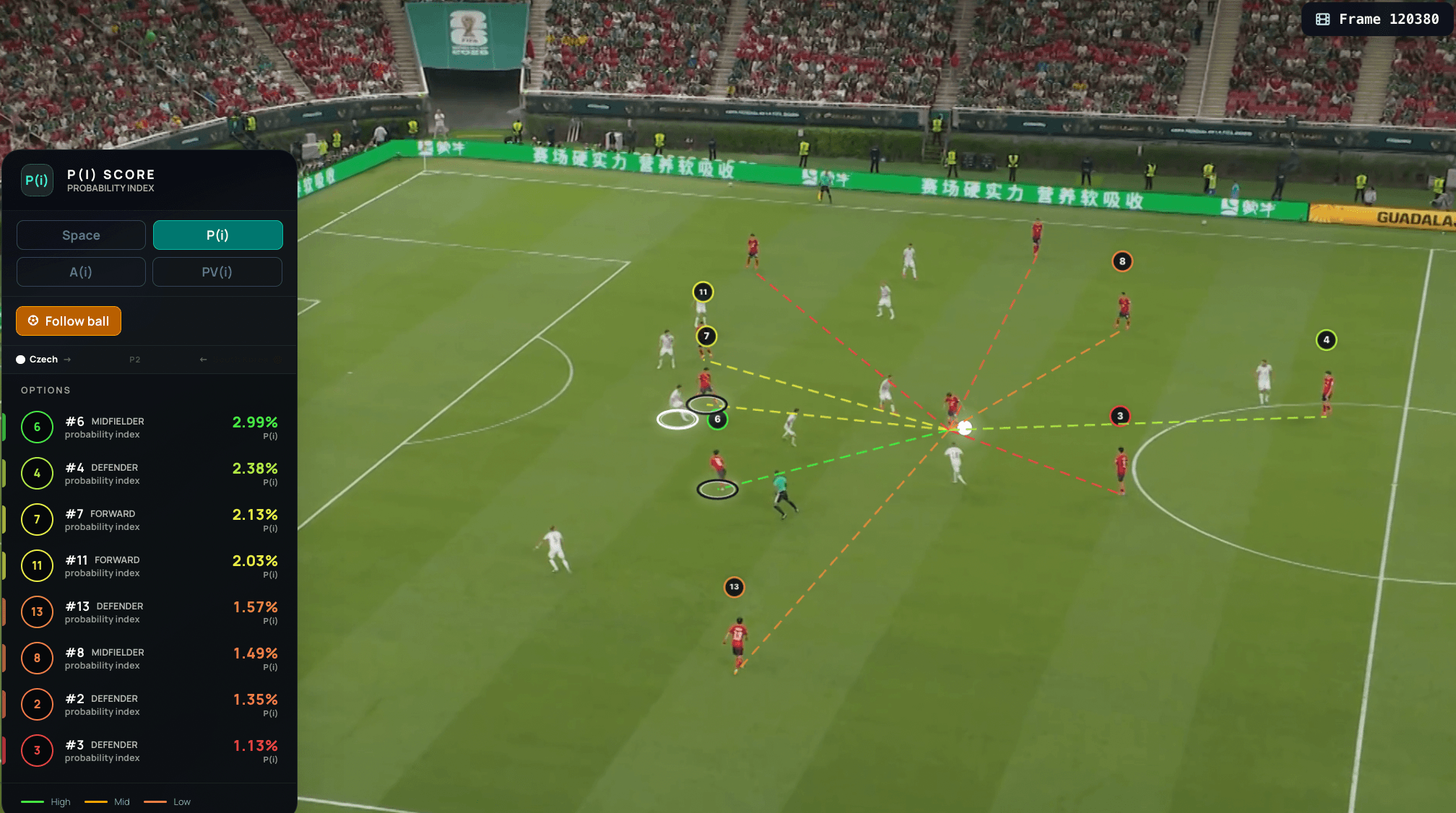
Kang-In identified the opportunity and threaded a pass into Hwang's path. Hwang then bypassed both the recovering Hranáč and goalkeeper Matěj Kovář with a clever feint before finishing calmly.
The goal illustrates how South Korea combine collective structure with individual freedom. Their use of wingbacks, central rotations, and coordinated movements consistently generated space, while Kang-In's awareness and creativity allowed them to capitalise on it.
Summary
South Korea's 2–1 victory over Czech Republic showcased a possession model that effectively balances positional structure with individual freedom. Through coordinated rotations, a well-functioning box midfield, and aggressive wingback positioning, they consistently manipulated the Czech defensive block and progressed the ball into dangerous areas.
At the heart of this approach was Lee Kang-In. His movement, creativity, and ability to exploit space gave South Korea a constant attacking reference point, whether receiving the ball himself or creating opportunities for others through his clever movements and positioning.


