

Germany's comeback against Ivory Coast was ultimately decided by a tactical battle between Ivory Coast's compact pressing structure and dangerous transitions, and Germany's second-half adjustments, which gradually removed the spaces in which Ivory Coast had thrived.
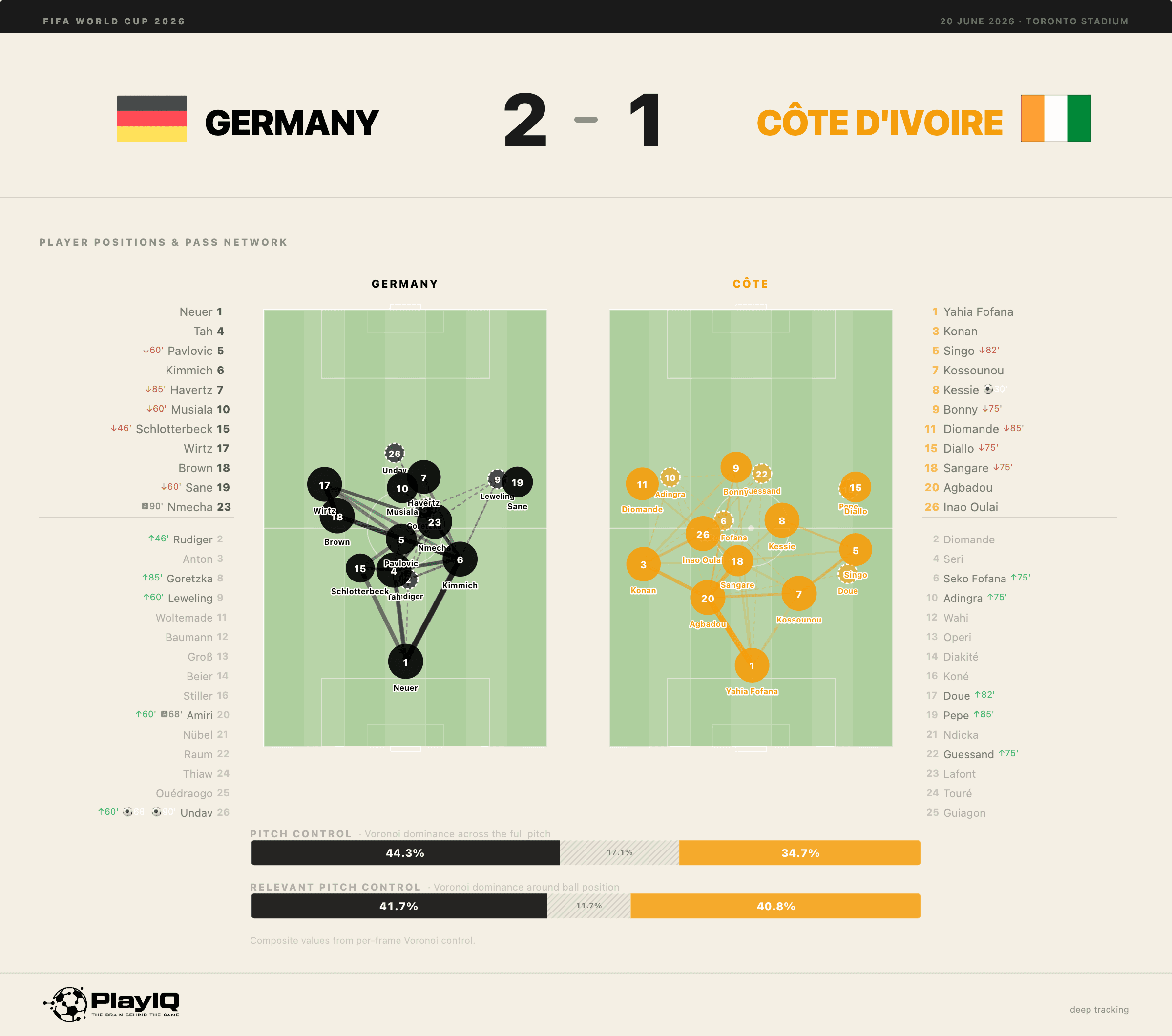
The match dashboard above shows the average player positions and passing networks of both teams against the medium block. The first observation we can make is that Germany had a more narrow approach, while Ivory Coast was more stretched out. This tells us something about the two teams' different offensive approaches. Another interesting observation is that while Germany held significantly more control of the pitch, the relevant pitch control is quite evenly split — suggesting that both teams were positioned evenly around the ball.
In this article, we will examine how both teams' defensive and attacking structures shaped the game's flow, starting with Ivory Coast's compact pressing system and its use of Diomandé as a transition outlet, before turning to Germany's second-half adjustments which ultimately removed the conditions that had made Ivory Coast's first-half approach effective.
The Collective: Ivory Coast
A feature of Ivory Coast's defensive approach was their pressing triggers. Whenever Germany circulated possession slowly or played backwards, the Ivorians looked to increase pressure and force mistakes.
When defending in a medium block, Ivory Coast often organised themselves in a compact 4-3-3 shape designed to restrict Germany from manoeuvring in central areas.
The following clip reveals this. By dropping into midfield, Havertz looks to create uncertainty over who should mark him. The Ivorians, however, use Havertz's movement inside their block as a pressing trigger, prioritising threats centrally.
From a deeper defensive phase, Ivory Coast initially defended in a 4-1-4-1 structure. When pressing opportunities emerged, wingers Amad Diallo and Yan Diomandé advanced onto Germany's high defensive line, transforming the shape into the same compact 4-3-3 used in the medium block.
The pressing angles were particularly important. By pressing from the outside in, the wingers prevented easy progression down the flanks and encouraged Germany to play centrally. This directed possession into congested areas where the Ivorian midfield was positioned to step in aggressively and contest the ball.
The defensive traps described above were not only designed to win the ball back, but also to create the type of transition moments Ivory Coast wanted. By forcing Germany into central turnovers while committing numbers forward, the Ivorians could immediately attack the spaces left behind the German structure.
The Individual: Yan Diomandé
The pressing strategy was particularly suited to putting Yan Diomandé in isolated 1v1 attacking situations, where his pace and physicality make him especially dangerous. Diomandé arrived at this World Cup off the back of a breakthrough Bundesliga season at RB Leipzig, and had already announced himself with an impressive performance against Ecuador. Nagelsmann and his staff were well aware of the threat he posed, yet Kimmich was tasked with covering him man-to-man — an interesting tactical decision. Ivory Coast, clearly prepared for this, responded with coordinated movements designed to pull Germany's defensive structure apart.
The clip above illustrates how Ivory Coast planned to release Diomandé. Initially Kimmich has total control over Diomandé and the space behind him, with a pitch control of 5.8%. To disrupt this, Diomandé makes a fake run towards Konan, looking to drag Kimmich higher up the pitch. Simultaneously, Oulai makes a run towards Konan, pulling Nmecha along with him. Konan reads the situation and releases Diomandé into the space behind. With both Nmecha and Kimmich drawn out of position, the space opens up — effectively increasing Diomandé's pitch control from 0.7% to 3.6%.
A similar sequence contributed directly to Ivory Coast's opening goal. With Germany defending in a medium block, the play shifts from right to left and Diomandé signals Konan to move inward, opening space for himself on the outside. This time, Kimmich holds his position rather than following. However, this allowed Diomandé the time and space to drive and get the cross into the box.
Coach Impact
In order to regain control of the game, Nagelsmann made some tactical tweaks which we will explore in more depth in the following section. Notably, the introduction of a more traditional No. 9 in Deniz Undav proved decisive.
Germany's first-half issues did not stem from a lack of possession, but rather from their vulnerability when in possession. To address this, Germany gradually altered both their spacing and their occupation of central zones throughout the game.
The introduction of Undav changed Germany's dynamic in the final third. By pinning the centre-backs — combined with greater width from Brown and Jamie Leweling — Germany made it more difficult for the Ivorians to maintain the compact midfield structure that had fuelled their pressing success in the first half.
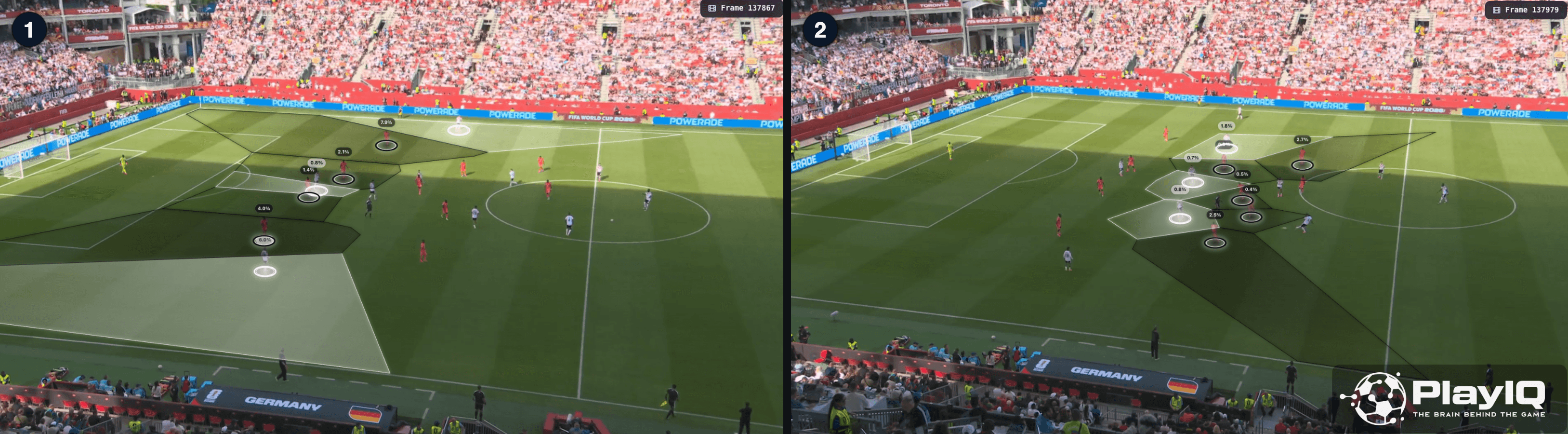
Germany increasingly found more space for players such as Wirtz, Havertz and substitute Amiri to move between the lines, allowing them to receive the ball more frequently in the half-spaces.
Germany's opening goal captured the impact of their adjusted in-possession structure. With better width-holders stretching the opponent horizontally, and Undav timing his movements well between pinning the back line and dropping into midfield, more central space became available.
Why Diomandé Disappeared
Diomandé had been Ivory Coast's most dangerous player in the first half, but Germany eventually found solutions to deal with this constant threat in wide areas.
Schlotterbeck's injury brought Rüdiger on, who immediately switched sides with Tah to provide cover on the right. Whereas Kimmich had often been left isolated against Diomandé in the first half, Rüdiger now positioned himself between Diomandé and Bonny. This allowed him to attack the aerial duels, provide cover whenever Kimmich stepped out, and largely neutralise Ivory Coast's most dangerous outlet.
Germany's attacking substitutions reinforced this further. With Rüdiger and Leweling sharing the defensive burden on the right, Diomandé's influence continued to fall and Kimmich was freed to push higher up the pitch.
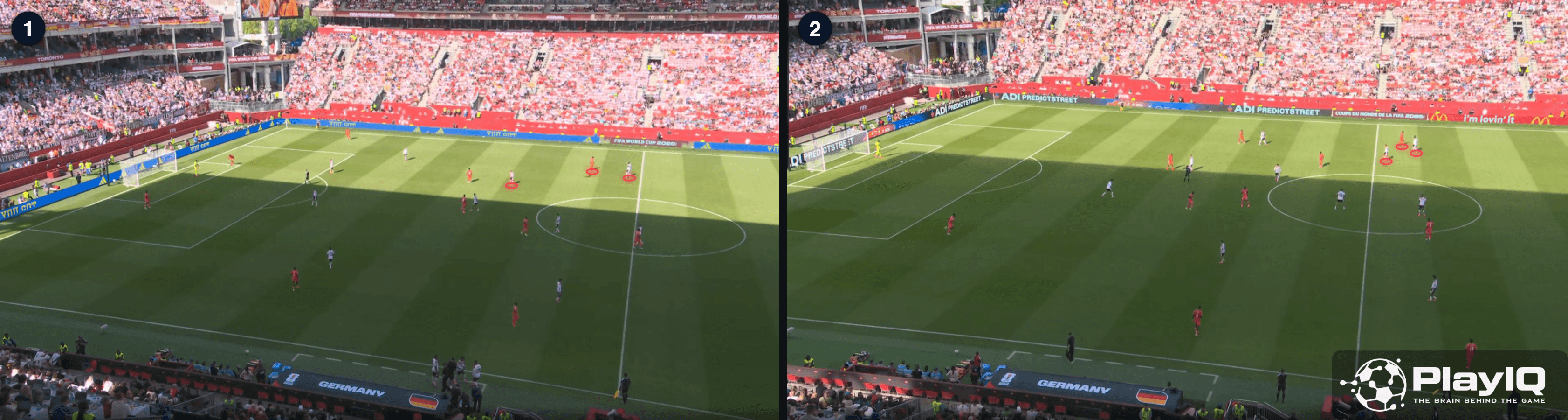
Following the second hydration break, Ivory Coast responded with a triple substitution and moved Diomandé to the right flank. While this created a few promising moments, Germany managed these situations far better, and Diomandé was substituted off 10 minutes later.
The Structural Trade-offs in Decisive Moments
As Germany pushed for a winner, Brown's advanced positioning left Tah isolated after his cross was cleared to Diomandé's replacement, Nicolas Pépé, allowing Ivory Coast to break in a 3v2 transition. Germany escaped when Simon Adingra failed to convert, highlighting the vulnerability created by their more aggressive structure.
Moments later, however, those same structural changes paid off. Building down the left once again, Germany found Nmecha in central space with time on the ball. With Ivory Coast's block stretched horizontally, Nmecha was able to thread a precise line-breaking pass through the defence. Undav, placed between the two Ivorian centre-backs, received on the half-turn before getting his shot away quickly and finding the back of the net.
The clip above shows both of these examples, and signifies the margins which define results — and whether the tactical trade-offs are deemed successful or not. Germany altered both their structure and personnel to create greater central access, accepting increased defensive risk in return.
As each side adjusted its structure and player roles in response to the other, the balance of control shifted repeatedly. Ultimately, the match was decided by fine margins, where Germany's attacking adaptations proved just enough to win the game — but it also highlighted vulnerabilities in their team.


