


Japan's 2026 World Cup ended in the Round of 32 with a 2-1 defeat to Brazil, but their tournament showed a team with a clear and adaptable tactical identity. Across the competition, Japan combined a compact defensive structure with an attacking plan based on patience, wide overloads, and combinations in tight spaces.
In Part 1 of our two-part analysis, we looked at how Japan defended. In this second installment, we look at their expansive offensive structure, and specifically how they used patience and wide overloads to break down opponents and create chances.
Attack vs Medium Block
One of Japan's important build-up ideas was to drop one of the number sixes into the back line when they had possession. This gave them an extra player in the first line of build-up and allowed one of the outside centre-backs, usually the left-sided defender Hiroki Ito, to move higher. By doing this, Japan could create better control on the side of the pitch, support their wide attacks and ultimately stretch the opponent horizontally.
However, this movement also had a weakness. When one midfielder dropped into the back line, Japan often had fewer players in the middle of the pitch. This meant they could lose some central control, especially against teams that pressed well or had strong midfield players. But this was part of their game plan. Japan was not always trying to dominate the centre. Instead, they wanted to create advantages on the sides.
Patience and Wide Overloads
Japan were comfortable moving the ball from side to side being patient in possession. Their attacking plan was based on strong relationships between the wing-back, outside centre-back, number ten, and striker. These players combined in small spaces, especially near the touchline, because of Japan's many technical players who are comfortable under pressure.
They often tried to bring several players toward the strong side, where the ball was. This helped them create overloads, short passing options, and quick combinations. At the same time, Japan kept players ready on the weak side. When the opponent shifted across to defend the ball side, Japan could switch play quickly and attack the opposite side.
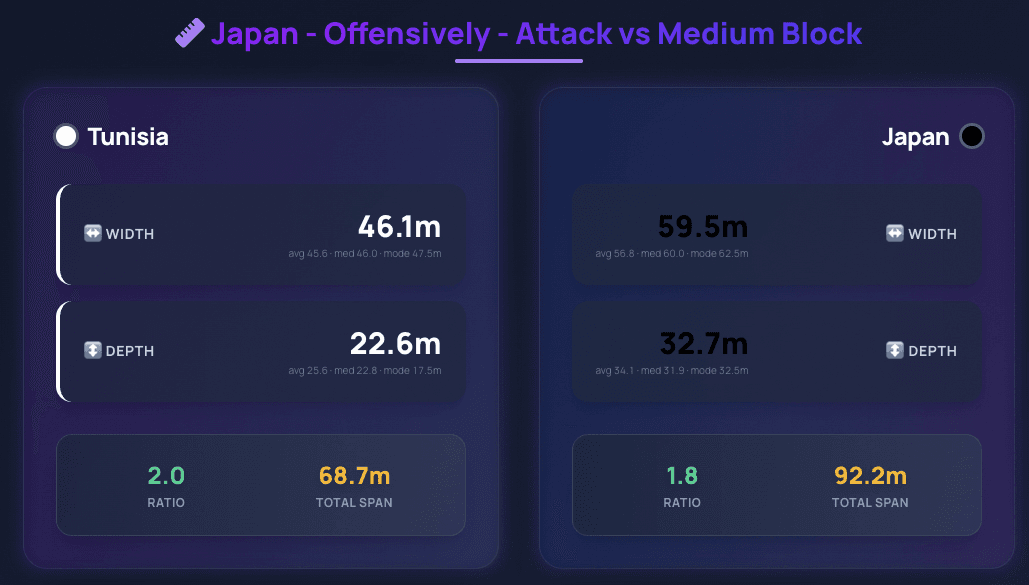
This was clear in their 4-0 win over Tunisia. Japan dominated the game with aggressive pressing, quick transitions, and patient possession. In fact, they operated with an average width of almost 60 meters when attacking against the medium block of Tunisia.
In the second half, they kept the ball, switched play from side to side, and looked for openings before scoring two more goals. That result became Japan's highest-ever goal tally in a World Cup match. Their goal below is a great example of how they used patience through switches to open up space inside centrally.
Their wide relationships also appeared against Sweden. Japan's best first-half chance came from a combination down the left between Kamada, Maeda, and Nakamura. Later, Japan took the lead through a well-worked move involving Sugawara, Doan, Ueda, and Maeda attacking the space behind the defensive line.
Attacking vs High Block
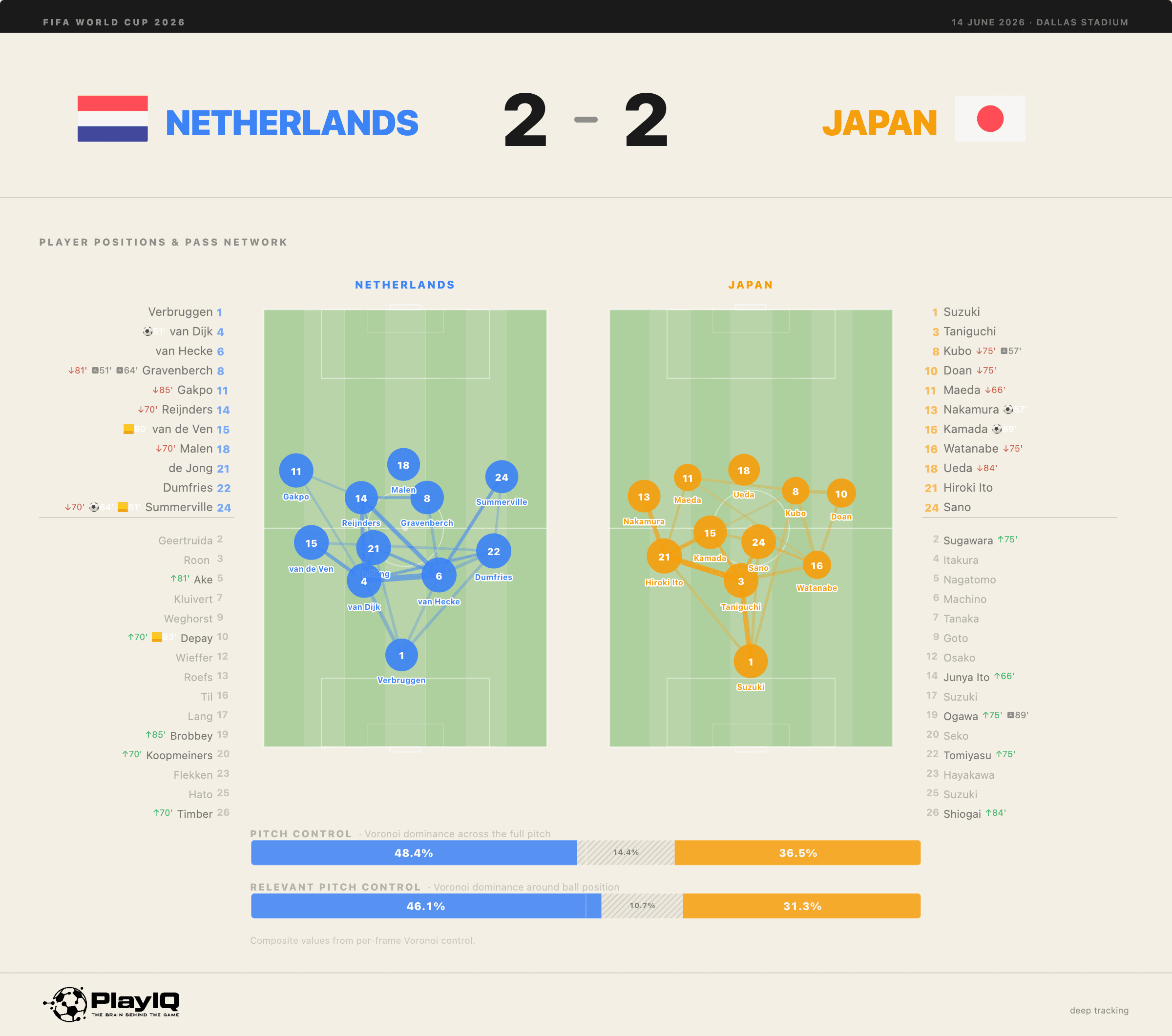
Another observation from Japan's offensive performance at the 2026 World Cup was how their build-up improved after the first game. Against the Netherlands, Japan had some problems progressing the ball from the back. They drew 2-2, but in possession they did not always have clean solutions when the Netherlands pressed them. Japan built up in a 4-2-4 structure, with the double pivot in front of the back line, but their rotations in the first phase were not always effective.
One of the main issues was the movement of the forwards who came low to receive. In the Netherlands game, the player dropping toward the ball was often the strong-side forward. This gave Japan one short option, but it did not really change the opponent's defensive shape. Because the support was coming from the same side, the Netherlands defense could anticipate the action and step up to prevent them from progressing.
Japan found solutions to this problem in the following games. Instead of only using the strong-side forward to come short, they started bringing the weak-side forward across to the strong side. This was a small but important adjustment. By moving the weak-side forward toward the ball, Japan created a numerical advantage around the strong side. Furthermore, it created a marking problem for the opponent. The weak-side forward gave Japan an extra passing option between the lines, and it also created better angles for third-man combinations. The adjustment also helped Japan stay true to their main attacking idea. They still wanted to overload the strong side, combine in tight spaces, and attract pressure.
At the same time, Japan did not completely abandon the weak side. Even when one weak-side forward moved across to help the build-up, Japan still kept width on the opposite side through the wing-back or another attacking player. This meant that if the opponent shifted too aggressively toward the ball, Japan could still switch play and attack the far side.
This improvement was clear in the next matches. Japan beat Tunisia 4-0 in their second group game, their biggest World Cup win, by scoring a goal which came through a beautiful buildup.
What Happened vs Brazil?
The problem against Brazil was that Japan did not trust their offensive structure enough in the second half. After taking the lead through Kaishu Sano, they became too passive and stopped pushing up and controlling the ball. Their high block moments disappeared and Brazil gained more territory and control. This is reflected in Japan's 30 per cent pitch control throughout the game and 26 minutes defending in the low block, equal to 63 per cent of their out of possession time.
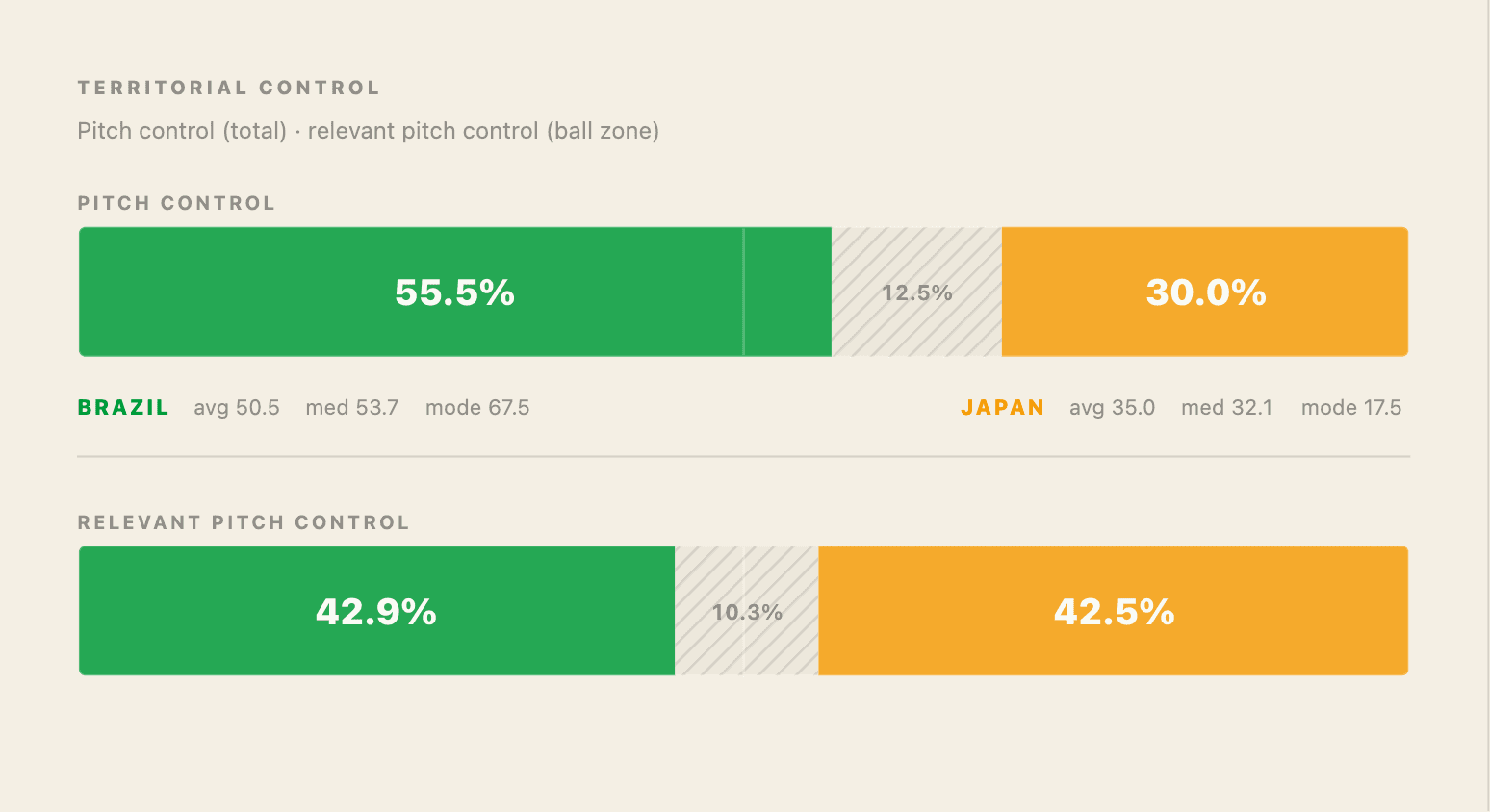
For large parts of the game, Japan held control within their own block, reflected in their block-relative pitch control, but they gradually gave up more of the field and were pushed deeper as a result, which shows up in their overall pitch control.
This was a missed opportunity because Japan had already shown they could solve pressure in different ways. Their build-up improved after the Netherlands game, especially when they started bringing the weak-side forward across to the strong side to create numerical advantages and better passing angles.
Summary
Japan were not eliminated because they lacked an attacking identity. Throughout the tournament, they had a clear structure: building patiently, using wide overloads, combining in tight spaces, and keeping the option to switch play and attack behind the last line. Their 3-4-2-1 gave them good relationships between the wing-back, wide centre-back, number ten, and striker, which helped them progress through the sides.
For Japan to go deeper in the competition, one can argue that more offensive bravery is needed in knockout games. With a clear attacking idea, they appeared to have the necessary tools to get past Brazil, even when the game became difficult.
Interested in tracking your own KPIs and game model, or just want to learn more about PlayIQ? Send us a message and let's talk football.


