

Japan's 2026 World Cup campaign ended in the Round of 32, but their compact and adaptable defensive block revealed a clear tactical identity and made them extremely difficult to break down.
In Part 1 of our two-part analysis, we examine how Japan defended and how, in key moments, that discipline began to tip into passivity.
Defensive Structure
Japan set up in a 3-4-2-1 formation in possession. Out of possession, however, the structure became a compact block where the two No. 10s dropped in alongside the central midfielders, and the wing-backs tucked into the back line to make a back five. The priority was staying compact and outnumbering the opposition centrally, pressing only when the right triggers appeared.

Low Block
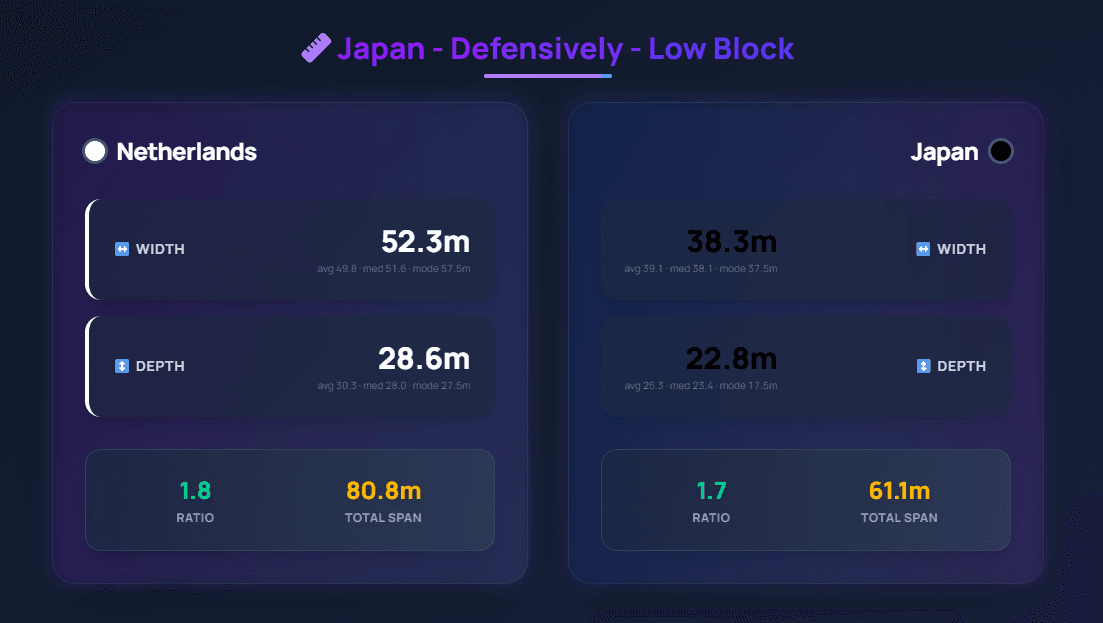
Japan's defensive block changed height depending on the opponent, but its purpose stayed the same: protect the centre and force play wide. Against presumed stronger teams, Japan defended deeper, using a low block for 62% (19m 38s) of their defensive time against the Netherlands and 63% against Brazil. Against weaker teams like Tunisia and Sweden, they spent more time defending in a medium block, respectively 53% and 52%. Independent of the block height, Japan stayed narrow and compact, with short distances between players, making it difficult for opponents to progress through the middle. Japan wanted to lead the Netherlands towards the wide areas, where they could press aggressively and win the ball back.
The insight below shows Japan's average width/depth in a low block, and the Netherlands' average attacking structure against it.
Medium Block
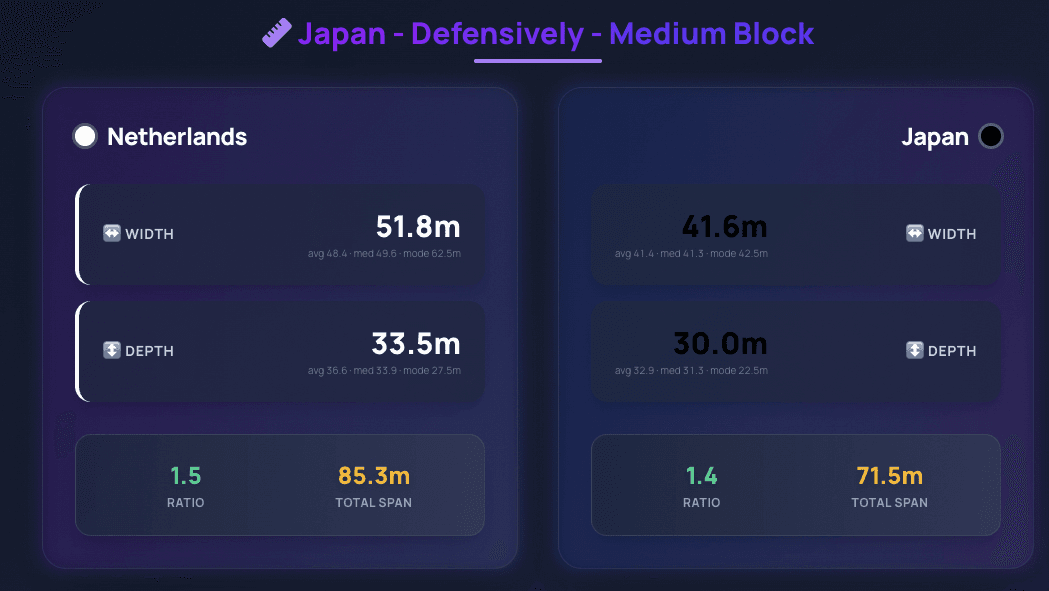
Japan did not simply sit back and wait. From within their compact block, they pressed selectively, using specific triggers such as a heavy touch, a pass into a tightly marked player, or a backwards pass as cues to step out and challenge for possession. Rather than pressing continuously, they remained disciplined until the right moment emerged. A clear example came during a medium block phase against the Netherlands, when Japan held their shape before collectively stepping out to regain the ball.
The insight below shows Japan's average width/depth in a medium block, and the Netherlands' average attacking structure against it.
High Block
At times, Japan chose to press high, for example on the opponent's goal kicks. Against the Netherlands, Tunisia and Sweden the effect was often the same: with the short pass cut off, the goalkeeper was forced to go long. This seemed to be a clear strategy from Japan, as they were well set up to deal with the long ball: a centre-back moving up to the intended target, with players close by to collect the second ball.
The insight below shows Japan's average width/depth in a high block, and Brazil's average attacking structure against it.

Unlike Japan's previous opponents, Brazil were willing to take greater risks in their build-up rather than accept the long ball. Japan responded by pressing aggressively, going man-to-man across the pitch and forcing mistakes deep inside Brazil's own half.
Disciplined or Passive?
There is a fine line between remaining disciplined in a low block and allowing that discipline to turn into passivity.
For 45 minutes against Brazil, Japan were arguably the better team. They led through Kaishu Sano, and PlayIQ's block control had them ahead 45 per cent to 40 in the first half, matching Brazil around the ball while sitting deep. Japan also showed occasional spells of keeping possession, frustrating Brazil at the end of the first half. At half-time, however, Brazil made changes to their shape, and the second half looked very different.
Endrick joined the attack, and Vinicius Junior moved wider towards the left. This gave Brazil greater width and stretched Japan's compact block horizontally, creating more time and space to deliver crosses into the box. It became their main solution against the low block, and directly led to the equaliser.
The greater risk was not simply that Japan defended deep, but that they stayed there for too long. Defending in a low block demands constant concentration and significant physical effort, especially when the team offers little threat in transition or gets a hold of possession. Japan's block control fell from 45 per cent in the first half to 31 in the second, reflecting how much less they competed around the ball after the break. With no sustained pressure of their own, Brazil could keep attacking, recycle possession, and return the ball into the box. Japan were unfortunate to concede so late in added time, but once they stopped posing a threat, the equaliser increasingly felt like a matter of time.
Summary
Our analysis of Japan's defensive structure revealed a highly drilled team, capable of shifting between all three block heights while maintaining their compactness and aggression. However, Japan also demonstrated how a disciplined low block can gradually become passive, particularly when protecting a lead in the knockout stages.
In the next article, we turn our attention to Japan's attacking structure and examine how they looked to create chances.
Interested in tracking your own KPIs and game model, or just want to learn more about PlayIQ? Send us a message and let's talk football.


