


Welcome to the PlayIQ World Cup series.
Throughout the tournament, we will deliver tactical analysis supported by PlayIQ's analytical layers and models, allowing us to go deeper into key moments and provide context beyond the eye test.
For our first article, we have analysed Brazil vs Morocco: a game shaped by tactical trade-offs, high-level decision-making, and fine margins.
Here is how the teams set up:
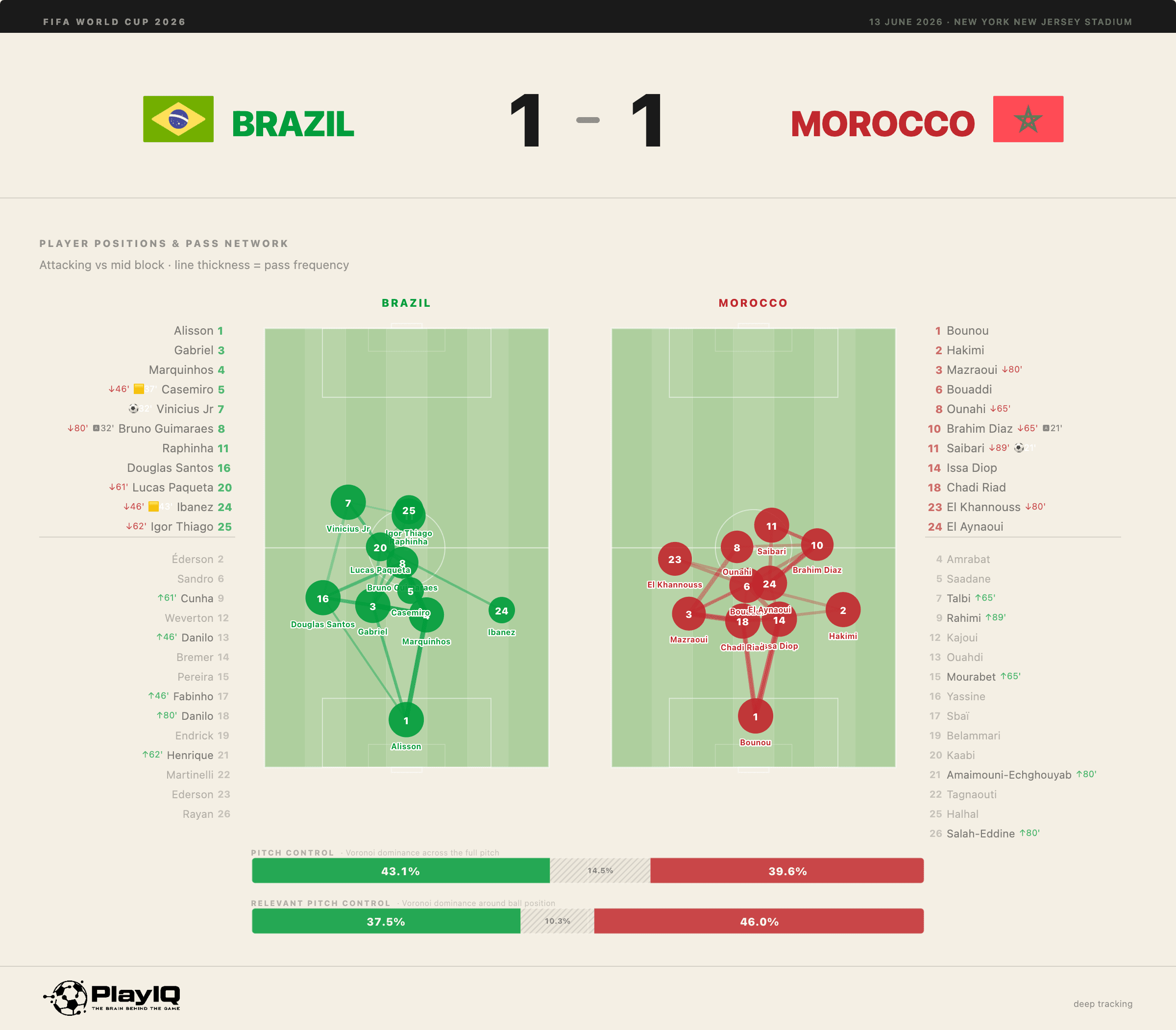
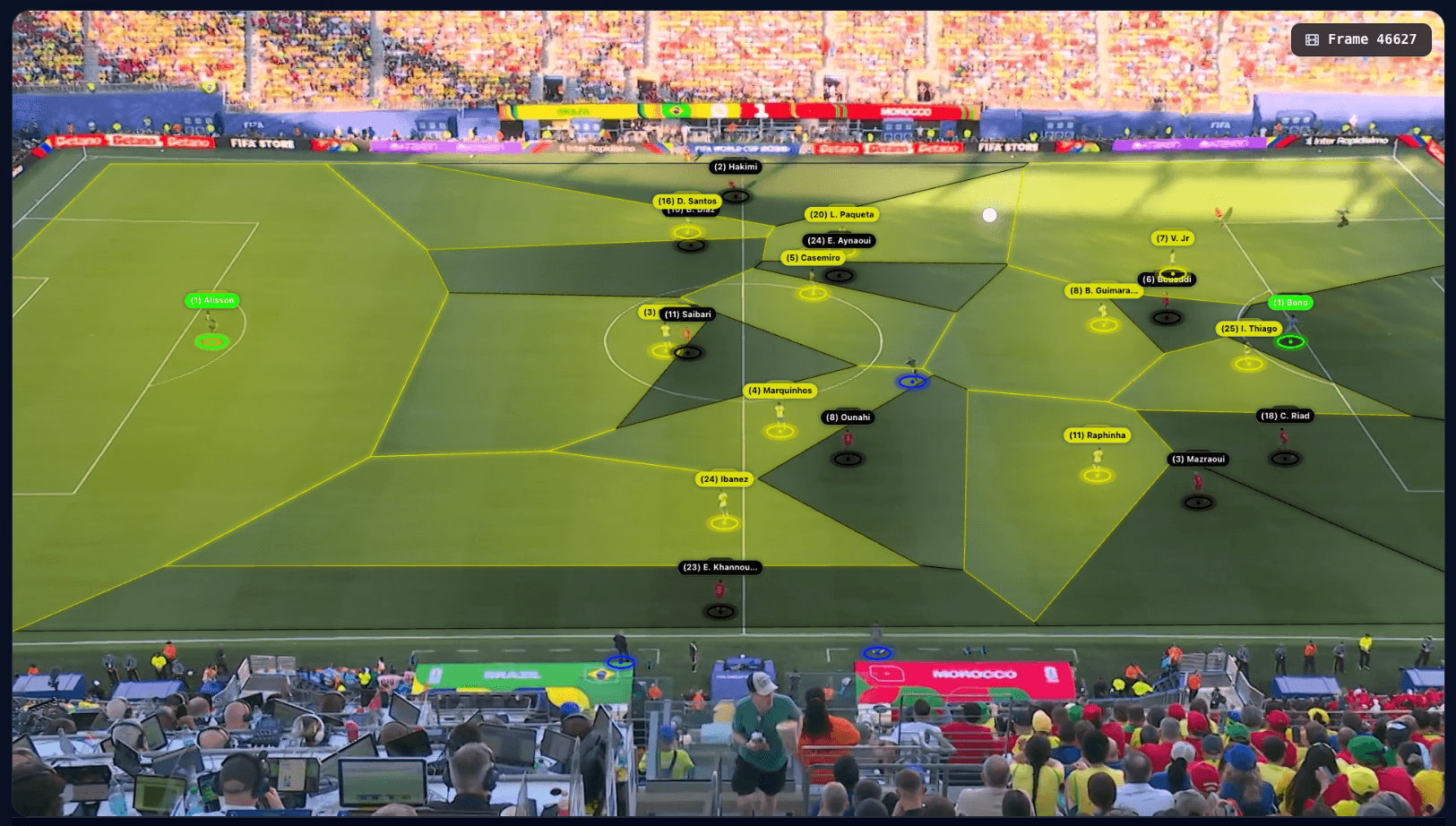
The dashboard above uses PlayIQ's deep tracking data to illustrate the average positions of both teams when attacking against an opponent in a medium block. Several interesting patterns emerge:
The first is Vinícius Júnior's high and wide positioning for Brazil. Given that he is one of their most dangerous attacking players, Brazil appears to deliberately isolate him in wide areas to maximise his one-versus-one opportunities. In contrast, the right side of Brazil's attack provides relatively little width. Their passing network is also notably congested, with most connections concentrated in central areas, reflecting what was effectively a 4-2-3-1 structure in possession.
Morocco, by comparison, displays a much more decentralised passing network. More player nodes remain connected to one another, and the strength of the connections is distributed more evenly across the team. This type of network structure is often indicative of a well-coordinated and cohesive collective, where ball progression and possession responsibilities are shared across multiple players rather than concentrated in a few key individuals.
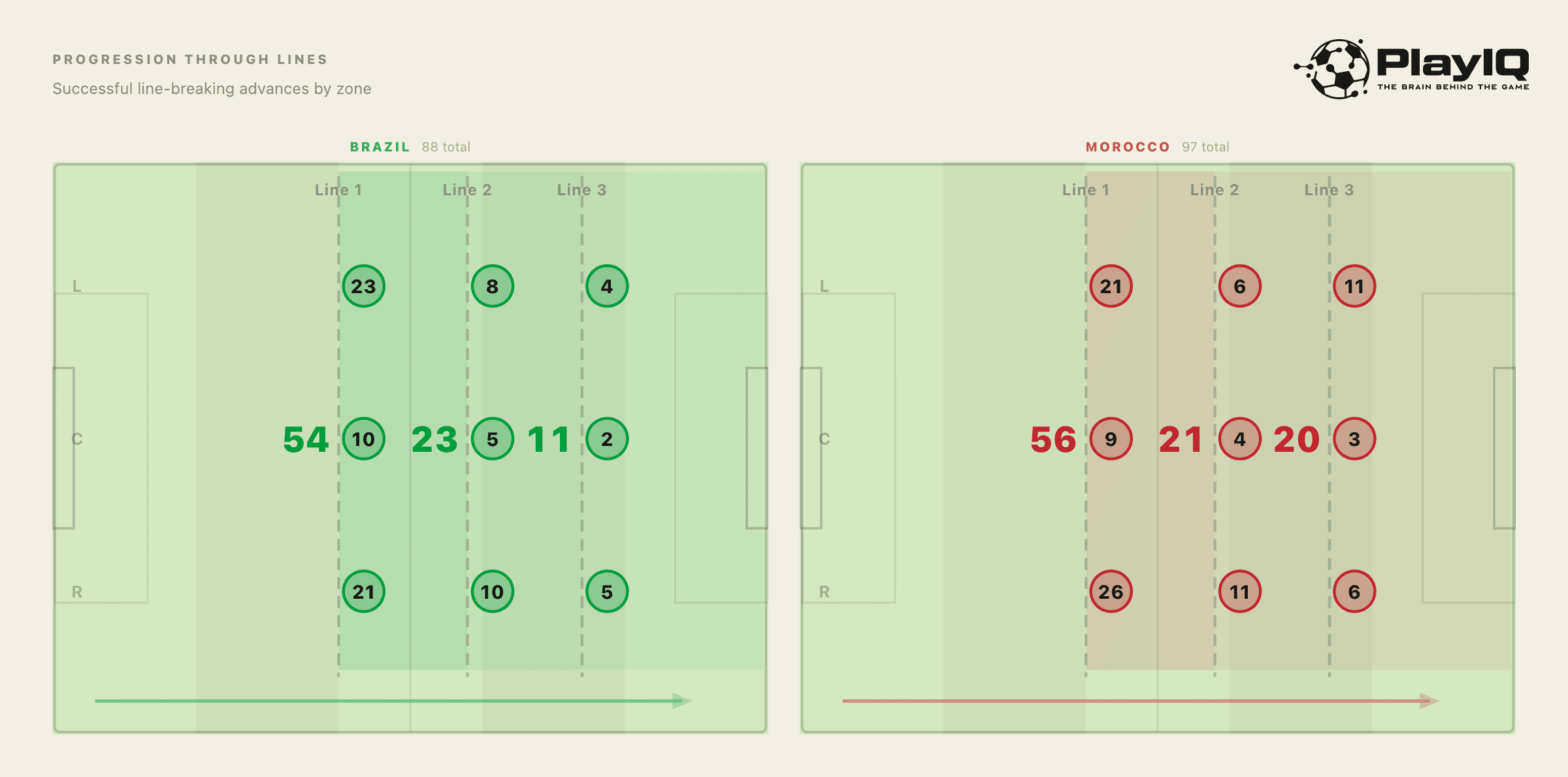
As we can see in the chart below, Morocco produced slightly more line breaks than Brazil — particularly behind the first and second line on the right-hand side, a detail that will make more sense later in the article.
Territorially, the match was quite balanced. Brazil controlled slightly more of the pitch overall (43.1% to 39.6%). The picture shifts, however, when we narrow the lens to relevant pitch control — control measured only within the active zone surrounding the ball. There, Morocco led 46.0% to 37.5%, suggesting they were generally better positioned around the ball even as Brazil held more of the pitch as a whole.
In the next section, we will analyse the goals using pitch control and passing option models. This will allow us to examine the tactical decisions behind each scoring sequence and assess the trade-offs made by both teams throughout the match.
Communication is Key
Brazil initially built their attack down the right side, but lost possession as they tried to progress. From there, their reaction after the turnover was too passive, which gave Mazraoui time to receive and lift his head at left-back.
As a right-footed player on the left side, Mazraoui is naturally positioned to play inside or diagonally across the pitch, allowing Morocco to escape the pressure and attack the space Brazil have left open.
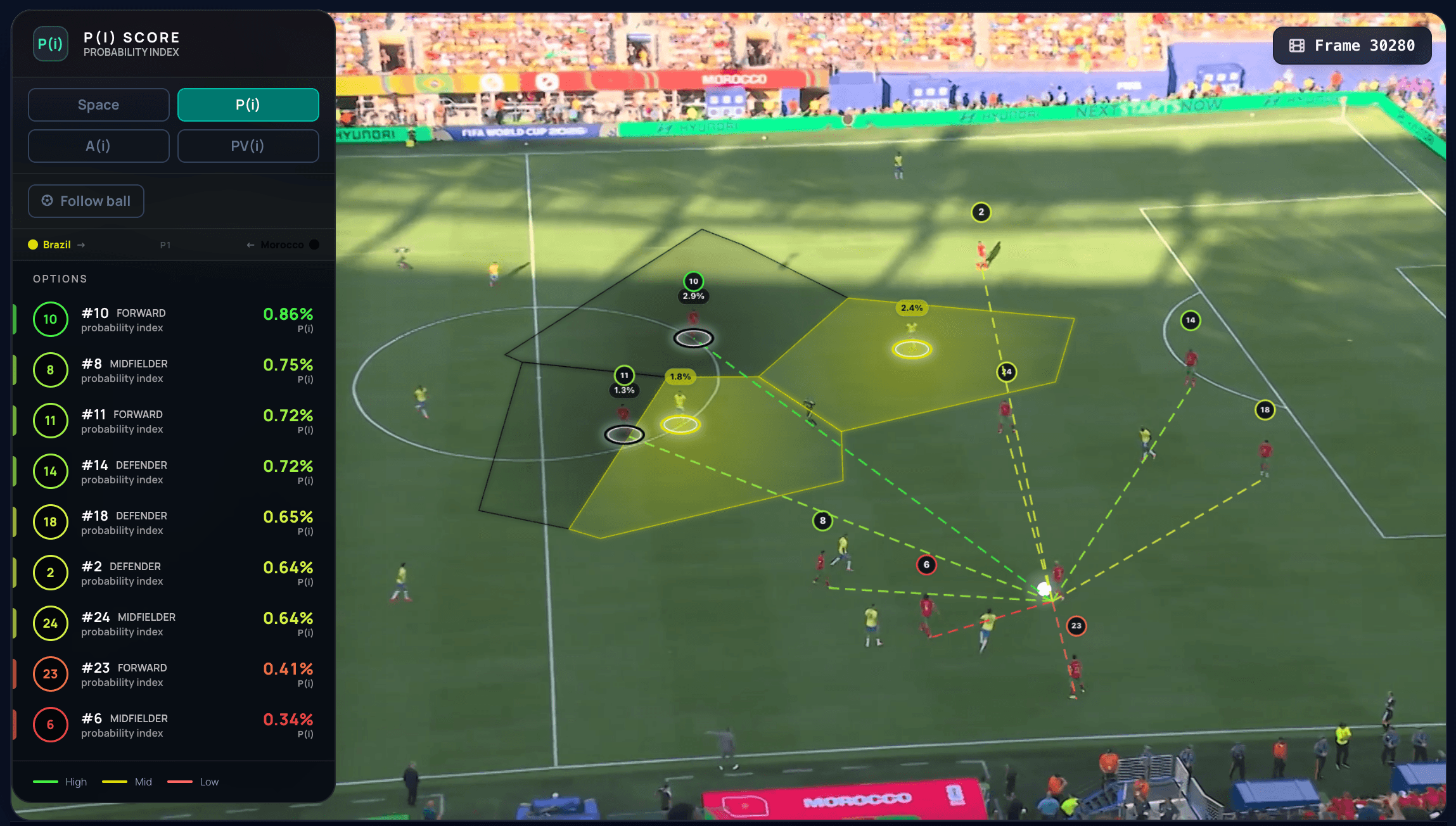
Using our probability-based model, we can assess his passing options in real time. The data shows that both Brahim and Saibari are viable options, highlighted by the green lines. However, Brahim's pitch control value of 2.5%, combined with his positioning, indicates that he is the passing option most likely to increase the team's probability of scoring.
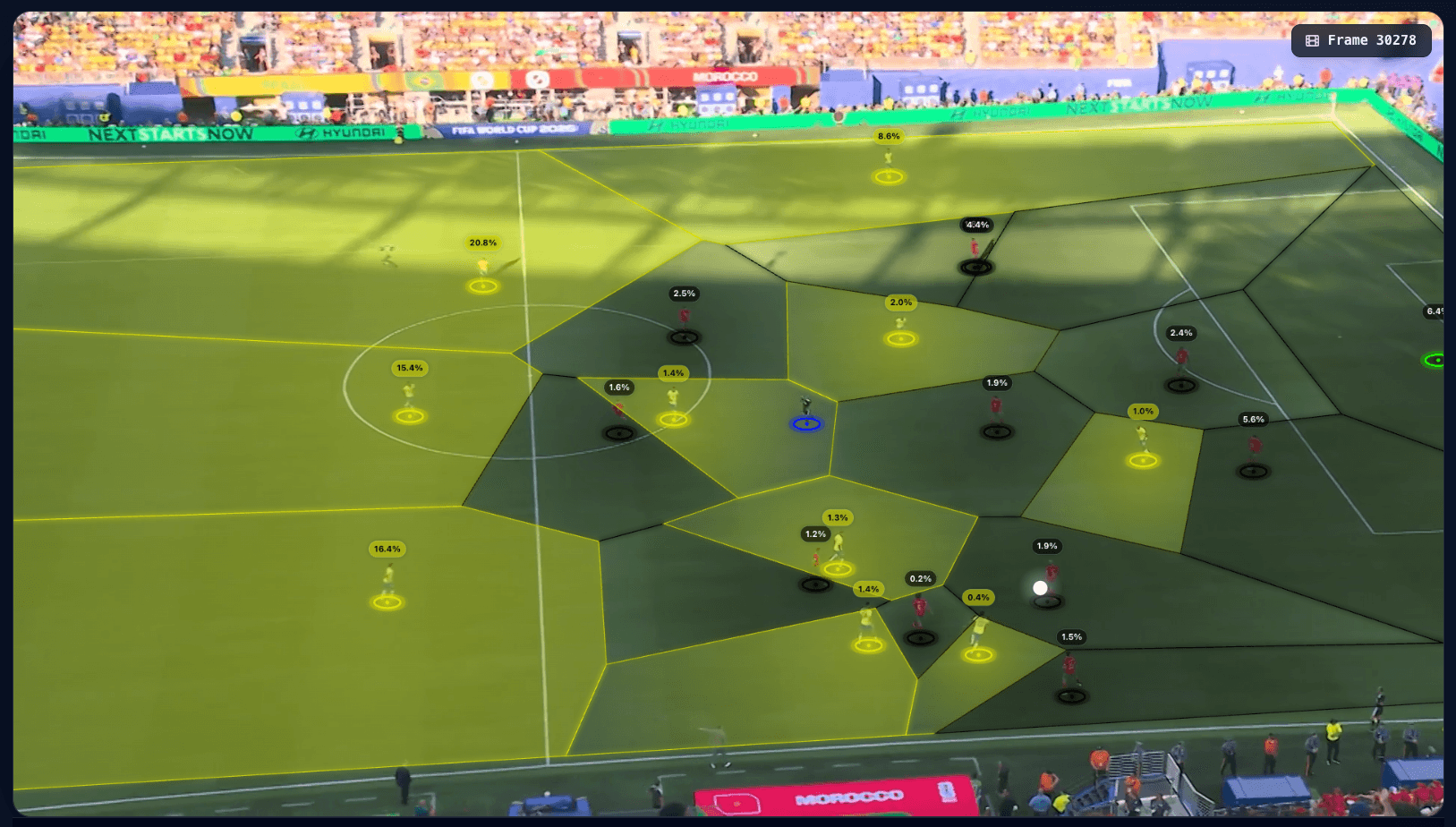
Isolating the pitch control of the most relevant players, we can see that Brahim has attracted three Brazilian defenders but still has enough space to receive and play forward. Hakimi's run on the right wing also increases Brazil's defensive uncertainty, while Vinícius' higher positioning appears connected to the team's tactical organisation and communication rather than an individual defensive error. This leaves Gabriel caught between stepping out to protect the space Hakimi is attacking, or closing the space in front of Saibari.
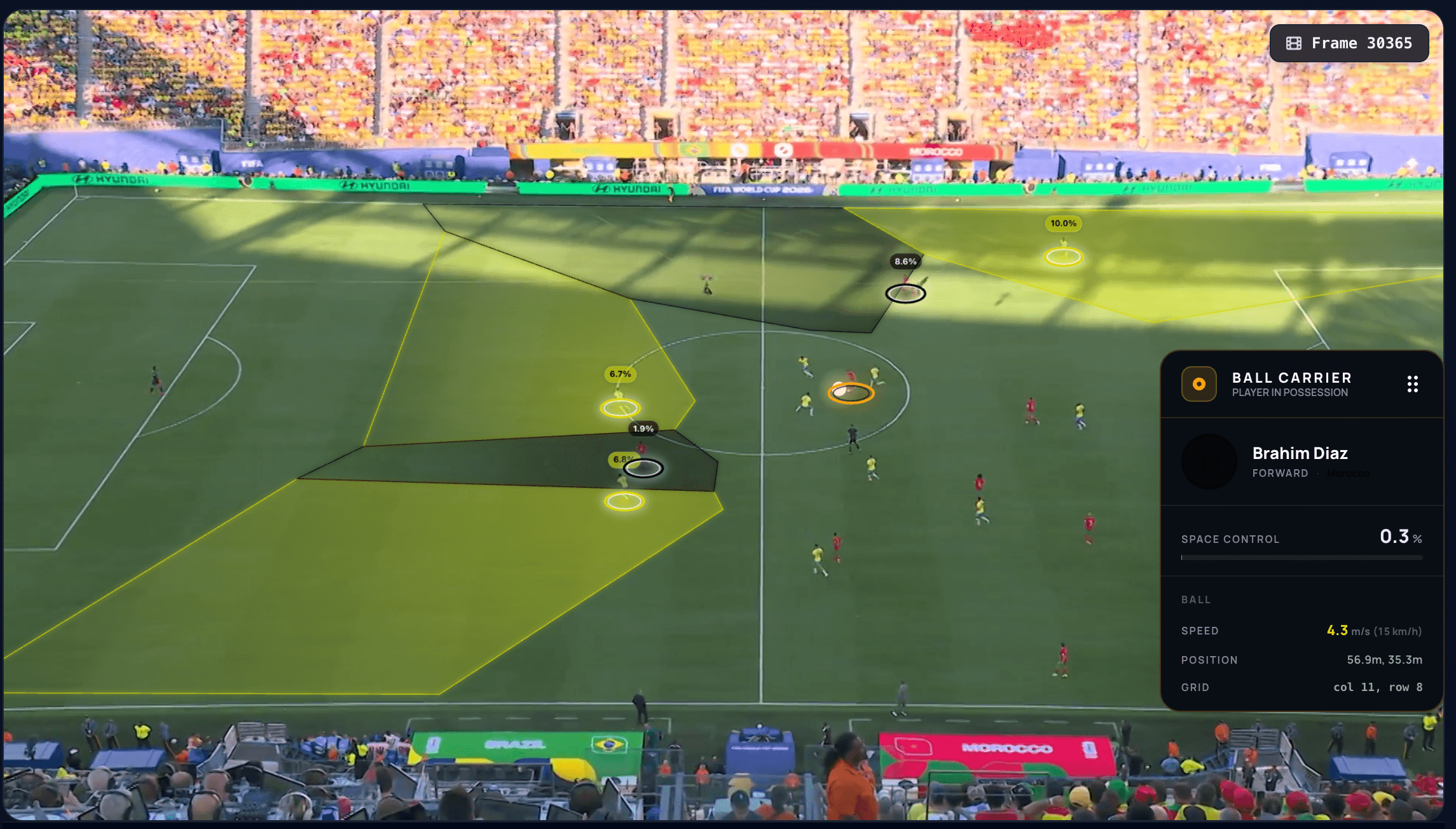
A perfectly weighted pass and a well-timed run allow Saibari to maintain relevant pitch control in behind Brazil's defensive line. Marquinhos should adjust across earlier to cover Saibari's run, as there is no immediate danger on his outside. This allows Saibari to attack the space with momentum and receive in a high-value area.
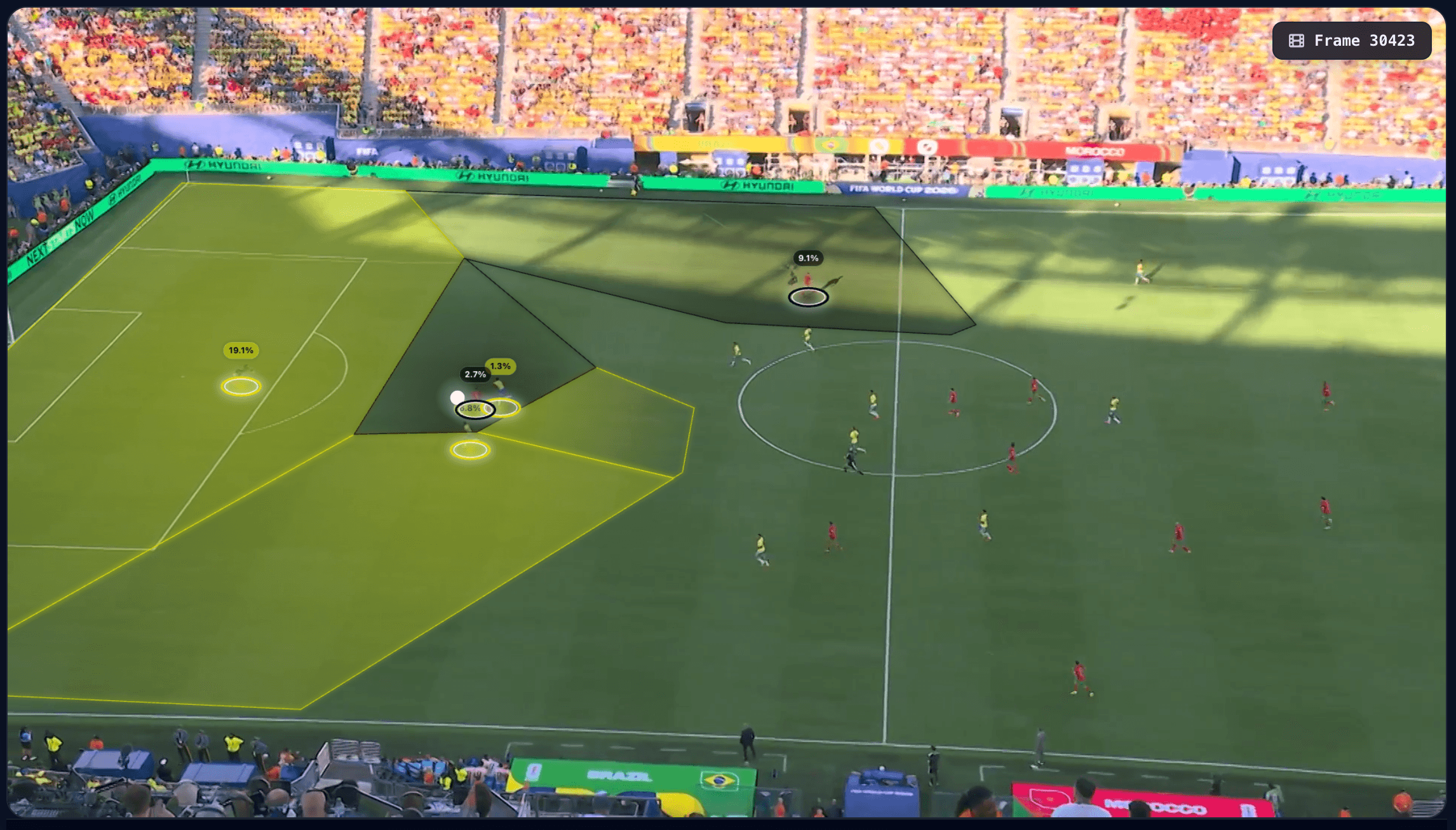
By analysing both the attacking and defensive perspectives, we can better understand the relationship between communication, tactics, and individual decision-making. At the highest level, the margins are incredibly small — a defensive recovery or a clean line break can hinge on a few metres of space and a split-second read. This is where pitch control and probability models help us quantify what the eye can easily miss.
Vini's Tactical Advantage
Brazil's equalising goal starts with a long goal kick from Bounou. Interestingly, Hakimi is the player who steps forward to attack the duel, which he eventually loses against Douglas Santos. By doing so, he risks leaving space behind him.
The second frame shows the ball dropping to Paquetá, who can immediately look for Vinícius. This time, Vinícius is able to take advantage of the high tactical position he has been occupying, especially with Hakimi now late to recover. We can also see that Morocco's back line is disorganised, keeping Vinícius onside.
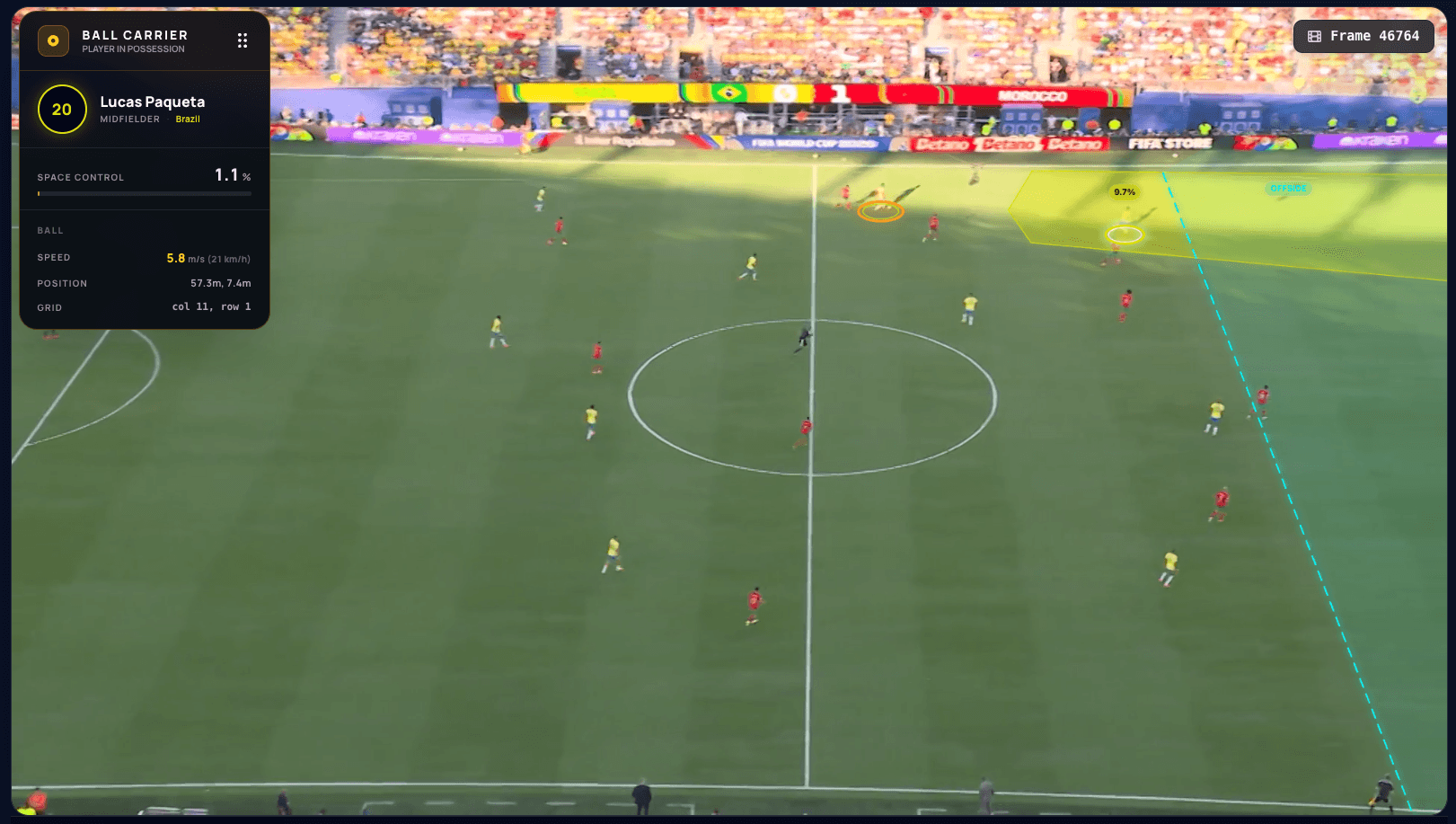
Vinícius thrives in these 1v1 situations, especially when he has space to attack in front of him. El Aynaoui fills in as a temporary right-back and initially recovers well, but then rushes out towards Bruno Guimarães unnecessarily. This opens a new gap for Vinícius to exploit, also marked as the most ideal passing option based on scoring probability.
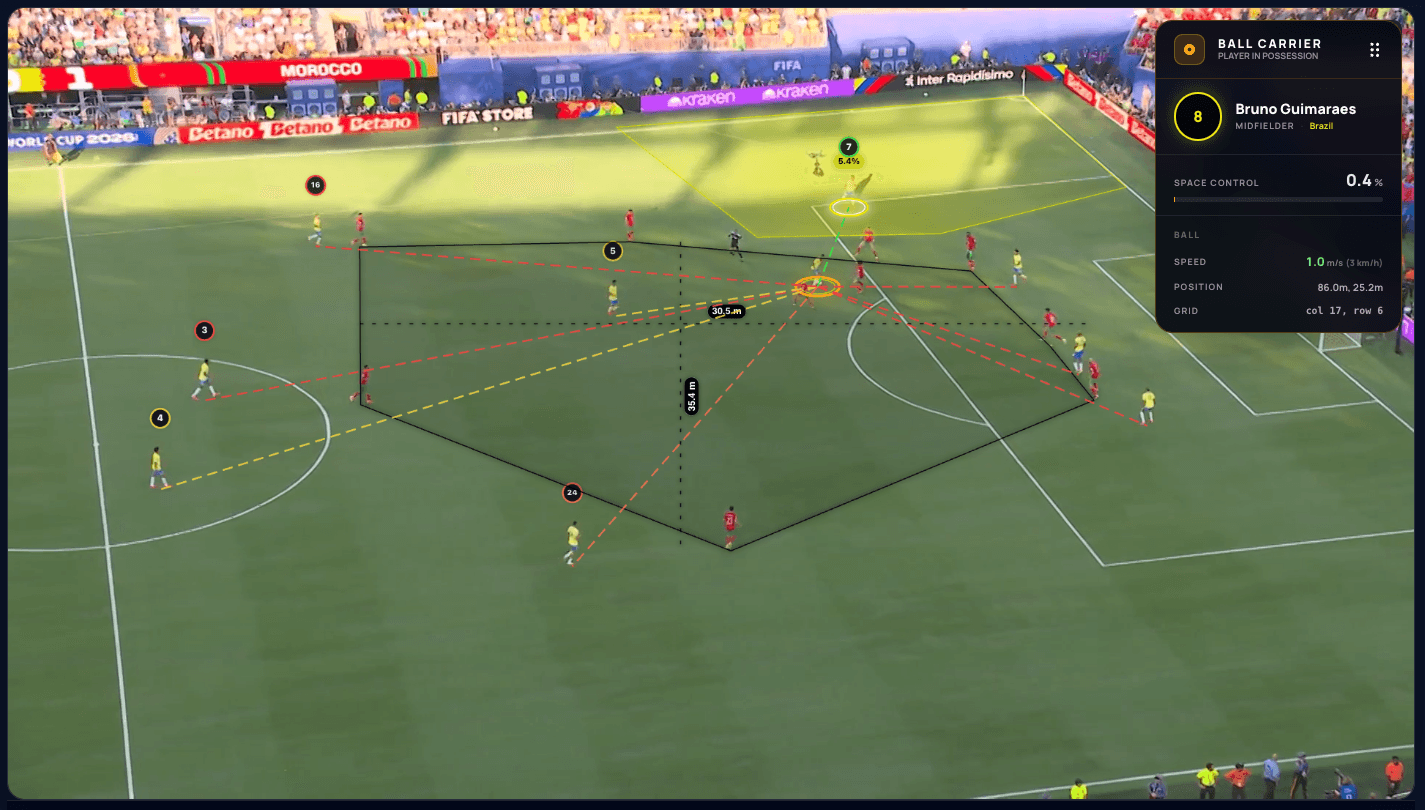
The pass is played between El Aynaoui and the centre-back. As El Aynaoui rushes back again, Vinícius can easily move inside and finish.
This sequence shows another example of tactical trade-offs. In the first goal, Vinícius' high position created potential vulnerability for Brazil defensively. However, in the equaliser, we see how that same positioning may have been an intentional choice by Brazil and Ancelotti to exploit the space behind Hakimi.
Fine Margins
Across both goals, the same theme holds: at this level the difference between a successful attack and a defensive recovery often comes down to a few metres of space and a fraction of a second. Brazil's decision to keep Vinícius high and wide carried a defensive cost on Morocco's opener, yet created the exact advantage they needed to equalise.
Interested in learning more about PlayIQ and how you can access our analysis tools and layers? Subscribe to PlayIQ insights below, or book a strategy call with us.


